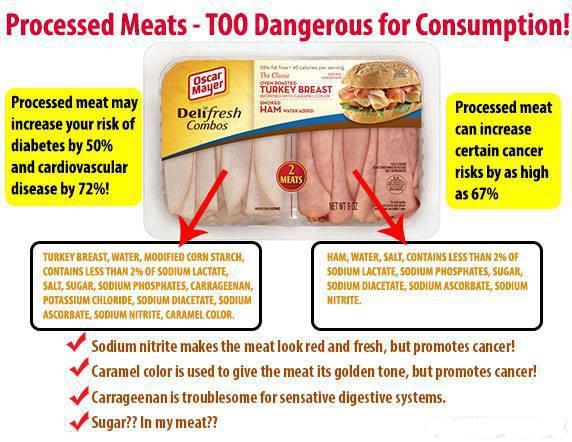
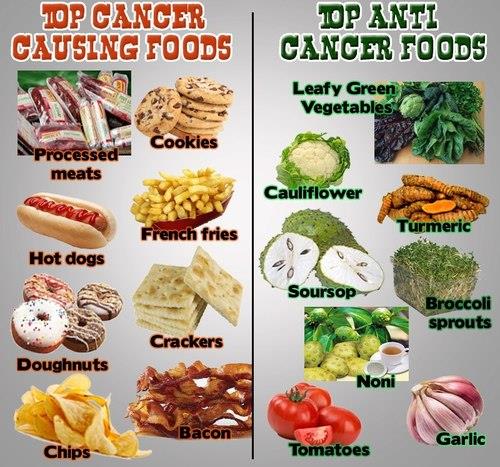
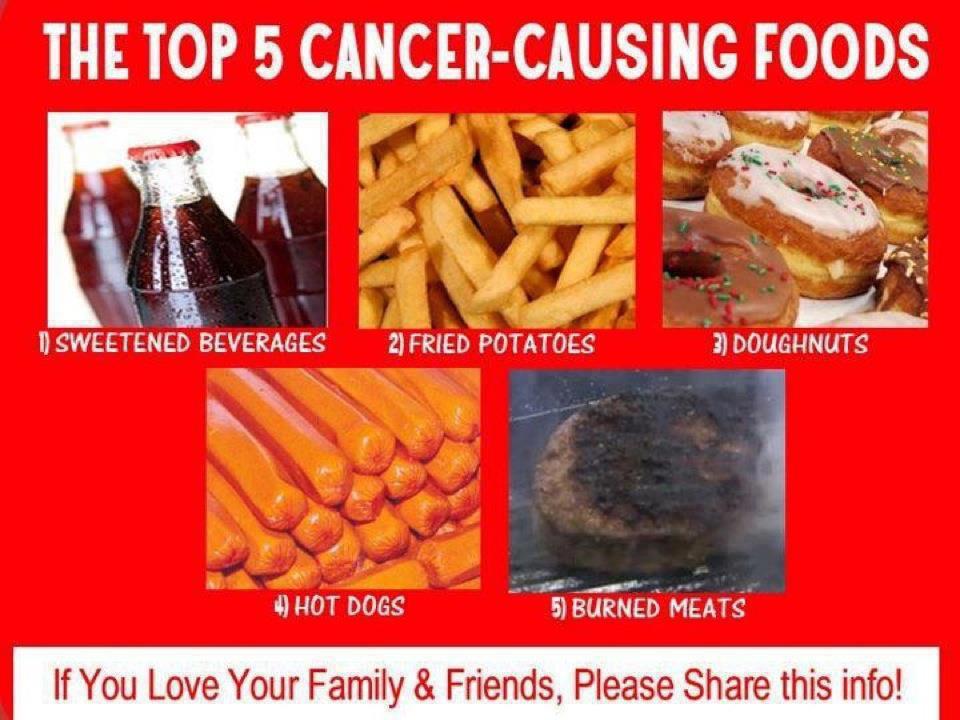
Processed Meats Too Dangerous for Human ConsumptionThe World Cancer Research Fund (WCRF) has completed a detailed review of more than 7,000 clinical studies covering links between diet and cancer. Bottom line: Processed meats are too dangerous for human consumption. Consumers should stop buying and eating all processed meat products for the rest of their lives. Processed meats include bacon, sausage, hot dogs, sandwich meat, packaged ham, pepperoni, salami and virtually all red meat used in frozen prepared meals. They are usually manufactured with a carcinogenic ingredient known as sodium nitrite. This is used as a color fixer by meat companies to turn packaged meats a bright red color so they look fresh. Unfortunately, sodium nitrite also results in the formation of cancer-causing nitrosamines in the human body. And this leads to a sharp increase in cancer risk for those who eat them. A 2005 University of Hawaii study found that processed meats increase the risk of pancreatic cancer by 67 percent. Another study revealed that every 50 grams of processed meat consumed daily increases the risk of colorectal cancer by 21 percent. These are alarming numbers. Note that these cancer risks do not come from eating fresh, non-processed meats. They only appear in people who regularly consume processed meat products containing sodium nitrite. Sodium nitrite appears predominantly in red meat products (you won’t find it in chicken or fish products). Here’s a short list of food items to check carefully for sodium nitrite and monosodium glutamate (MSG), another dangerous additive:
If sodium nitrite is so dangerous to humans, why do the FDA and USDA continue to allow this cancer-causing chemical to be used? The answer, of course, is that food industry interests now dominate the actions by U.S. government regulators. The USDA, for example, tried to ban sodium nitrite in the late 1970′s but was overridden by the meat industry. It insisted the chemical was safe and accused the USDA of trying to “ban bacon.” Today, the corporations that dominate American food and agricultural interests hold tremendous influence over the FDA and USDA. Consumers are offered no real protection from dangerous chemicals intentionally added to foods, medicines and personal care products. You can protect yourself and your family from the dangers of processed meats by following a few simple rules: 1 Always read ingredient labels. 2 Don’t buy anything made with sodium nitrite or monosodium glutamate. 3 Don’t eat processed meats served by restaurants, schools, hospitals, hotels or other institutions. And finally, eat more fresh produce with every meal. There is evidence that natural vitamin C found in citrus fruits and exotic berries (like camu camu) helps prevent the formation of cancer-causing nitrosamines, protecting you from the devastating health effects of sodium nitrite in processed meats. The best defense, of course, is to avoid eating processed meats altogether.
 Most Nations in the World Have No GMO-Free Platforms Most Nations in the World Have No GMO-Free Platforms To Protect Their Citizens. 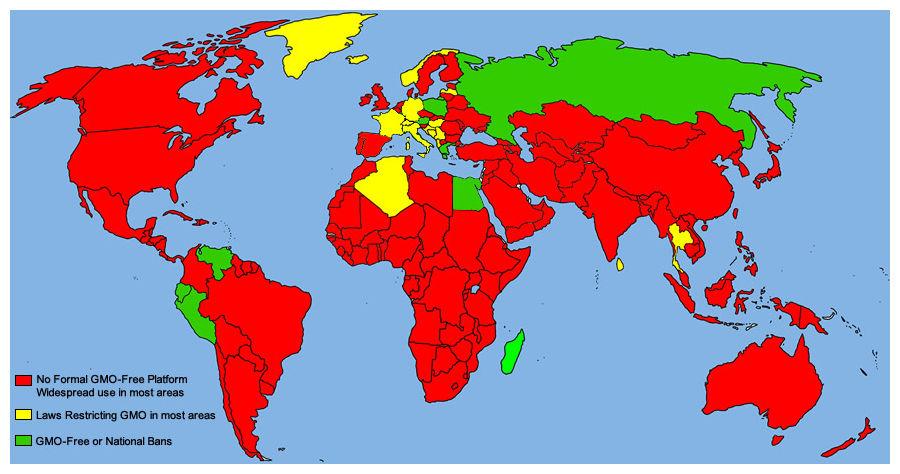
FYI :Nations with no formal GMO-Free platform (in red).
Nations with laws restricting GMO in most areas (in yellow), and
nations who are either GMO-free or have declared national bans (green).
Unless you live in the dozen or so nations in the world who have declared GMO (genetically modified organism) bans, then you're likely eating GMO. Eating organic is your best chance of avoiding GM foods, but it's almost impossible to avoid them entirely, especially if you're living in a country that doesn't restrict their cultivation, import or export. The United States, Canada, China, UK, Australia, Mexico, and most of South America, Asia and Africa have no formal GMO-free platforms and their use is typically unrestricted and widespread. The image above is a shocking reminder of how we have allowed biotech industries to take over our planet. It is my dream to one day see this image turn from the majority red to green. Countries represented in red have no enforced national laws banning GMOs, their import, export or cultivation. Most of these nations have a very large percentage of their citizens eating GM foods. If you're new to the dangers of GM foods, here are the 7 biggest reasons to avoid them. The 7 Biggest Reasons To Never Eat Genetically Modified Foods
You may not want to eat genetically modified
(GM) foods, but chances are, you are eating them anyway. There are
urgent reasons why we need to ban them altogether.
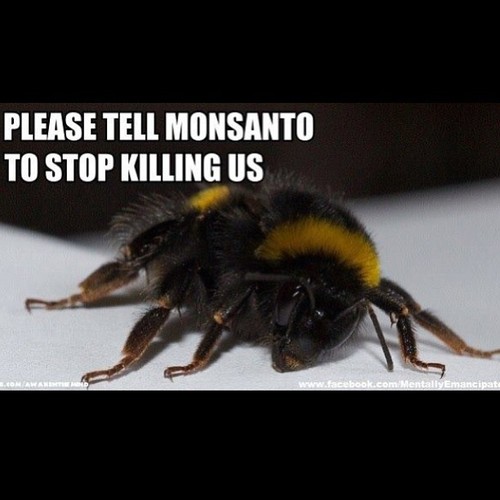
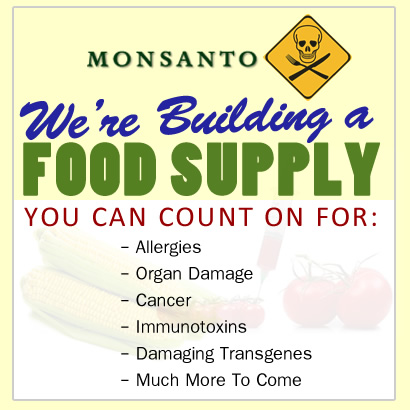
Monsanto is one of the most
malevolent organizations and
considered the most hated company in the world.
Genetically modified foods
are now accepted as one of the
biggest threats to all living things.
1. Increased Pesticide Use US government data shows that in the US, GM crops have produced an overall increase, not decrease, in pesticide use compared to conventional crops. “The promise was that you could use less chemicals and produce a
greater yield. But let me tell you none of this is true.” -- Bill
Christison, President of the US National Family Farm Coalition. It is claimed that Americans have eaten GM foods for years with no
ill effects. But these foods are unlabeled in the US and no one has
monitored the consequences. With other novel foods like trans fats, it
has taken decades to realize that they have caused millions of
premature deaths. “We are confronted with the most powerful technology the world has ever known, and it is being rapidly deployed with almost no thought whatsoever to its consequences.” -- Dr Suzanne Wuerthele, US Environmental Protection Agency (EPA) toxicologist 3. GM Foods Are Hidden In Animal Feed As a spokesperson for Asgrow, a subsidiary of Monsanto, said, "If
you put a label on genetically engineered food, you might as well put a
skull and crossbones on it." The GM industry has got around the
problem of consumer rejection of GM foods by hiding them in animal feed.
Meat, eggs and dairy products from animals raised on the millions of
tons of GM feed imported into Europe do not have to be labelled. Some
studies show that contrary to GM and food industry claims, animals
raised on GM feed ARE different from those raised on non-GM feed.Â
Other studies show that if GM crops are fed to animals, GM material can
appear in the resulting products and affect the animals’ health. So
eating these “stealth GMOs” may affect the health of consumers. The time has come to choose between a GM-based, or a non-GM-based, world food supply. “If some people are allowed to choose to grow, sell and consume GM foods, soon nobody will be able to choose food, or a biosphere, free of GM. It’s a one way choice, like the introduction of rabbits or cane toads to Australia; once it’s made, it can’t be reversed.” -- Roger Levett, specialist in sustainable development. 5. Long-term Economic Disaster For Farmers A 2009 report showed that GM seed prices in America have increased
dramatically, compared to non-GM and organic seeds, cutting average farm
incomes for US farmers growing GM crops. The report concluded, “At
the present time there is a massive disconnect between the sometimes
lofty rhetoric from those championing biotechnology as the proven path
toward global food security and what is actually happening on farms
in the US that have grown dependent on GM seeds and are now dealing
with the consequences.” The big biotech firms pushing their GM foods have a terrible history
of toxic contamination and public deception. GM is attractive to them
because it gives them patents that allow monopoly control over the
world’s food supply. They have taken to harassing and intimidating
farmers for the “crime” of saving patented seed or “stealing” patented
genes -- even if those genes got into the farmer’s fields through
accidental contamination by wind or insects. “Farmers are being sued for having GMOs on their property that they did not buy, do not want, will not use and cannot sell.” -- Tom Wiley, North Dakota farmer. 7. GM Foods Will Never Solve The Food Crisis A 2008 World Bank report concluded that increased biofuel production is the major cause of the increase in food prices. Biofuels are crops grown for fuel rather than food. GM giant Monsanto has been at the heart of the lobbying for biofuels -- while profiting enormously from the resulting food crisis and using it as a PR opportunity to promote GM foods! “The climate crisis was used to boost biofuels, helping to create the food crisis; and now the food crisis is being used to revive the fortunes of the GM industry.” -- Daniel Howden, Africa correspondent, The Independent (UK). “The cynic in me thinks that they’re just using the current food crisis and the fuel crisis as a springboard to push GM crops back on to the public agenda. I understand why they’re doing it, but the danger is that if they’re making these claims about GM crops solving the problem of drought or feeding the world, that’s bullshit.” -- Prof Denis Murphy, head of biotechnology, University of Glamorgan, Wales.NORTH AMERICA
SOUTH AMERICA
|

 Genetic modification is a crude and imprecise way of incorporating
foreign genetic material (e.g. from viruses, bacteria) into crops, with
unpredictable consequences. The resulting GM foods have undergone
little rigorous and no long-term safety testing. However, animal
feeding tests have shown that GM foods have toxic effects, including
abnormal changes in organs, immune system disturbances, accelerated
ageing, and changes in gene expression. Very few studies have been
published on the direct effects on humans of eating a GM food. One
such study found unexpected effects on gut bacteria, but was never
followed up.
Genetic modification is a crude and imprecise way of incorporating
foreign genetic material (e.g. from viruses, bacteria) into crops, with
unpredictable consequences. The resulting GM foods have undergone
little rigorous and no long-term safety testing. However, animal
feeding tests have shown that GM foods have toxic effects, including
abnormal changes in organs, immune system disturbances, accelerated
ageing, and changes in gene expression. Very few studies have been
published on the direct effects on humans of eating a GM food. One
such study found unexpected effects on gut bacteria, but was never
followed up.
 GM contamination of conventional and organic food is increasing. An
unapproved GM rice that was grown for only one year in field trials was
found to have extensively contaminated the US rice supply and seed
stocks. In Canada, the organic oilseed rape industry has been
destroyed by contamination from GM rape. In Spain, a study found that
GM maize “has caused a drastic reduction in organic cultivations of
this grain and is making their coexistence practically impossible”.
GM contamination of conventional and organic food is increasing. An
unapproved GM rice that was grown for only one year in field trials was
found to have extensively contaminated the US rice supply and seed
stocks. In Canada, the organic oilseed rape industry has been
destroyed by contamination from GM rape. In Spain, a study found that
GM maize “has caused a drastic reduction in organic cultivations of
this grain and is making their coexistence practically impossible”. Alfalfa is the main forage crop for dairy cows and one of the
principle foods for beef cows, especially grass-fed cattle. Alfalfa is
a perennial, easily lasting five years once planted. And it's
bee-pollinated, which means each year, every non-GM alfalfa plant
within five miles of every GM alfalfa plant will likely be
contaminated by GM genes.
Alfalfa is the main forage crop for dairy cows and one of the
principle foods for beef cows, especially grass-fed cattle. Alfalfa is
a perennial, easily lasting five years once planted. And it's
bee-pollinated, which means each year, every non-GM alfalfa plant
within five miles of every GM alfalfa plant will likely be
contaminated by GM genes.